0

Masons, Jews, and Mosaic Pavements

If you have been to the colonial Jewish synagogues in Curaçao, Barbados, or Suriname, or the (Old or New) Jewish Cemeteries in Curaçao, you will begin no notice recognize an interesting pattern: black and white tiles arranged in checkerboard fashion surrounding entrances to buildings and around the base of gravestones.  This pattern can also be seen in the nineteenth-century Jewish houses in the Scharloo district of Curaçao. It is often referred to by the name "mosaic pavement." (Mosaic Pavement outside Neve Shalom Synagogue in Paramaribo, Suriname at Left.)

Mosaic Pavement in the Newer Jewish Cemetery in Curaçao
If you are a freemason, the pattern will seem doubly familiar. Mosaic pavement was (and is) a staple of both Masonic architecture and ritual objects. Masonic carpets and later floorings employed the mosaic pavement motif. used the pavement in the center of their sanctuaries either in tile or on a rug, usually surrounded by a border and with the symbol of a blazing star at the center. Although Masons were not the only people to use this type of flooring during this era, mosaic pavement took on special resonance within Masonic rites and are usually noted in emblem charts (like the one below) and were often used in Masonic lodges during the eighteenth and nineteenth centuries.

Emblematic chart and Masonic history of F[ree] and A[ccepted] M[asons] / Ramsey, Millet, & Hudson Steam. Lith. Co. (Kansas City, Mo. : W.M. Devore, publisher, c1877). Courtesy of the Library of Congress, LC-DIG-pga-02426
Samuel Lee, Orbis miraculum
London, 1659
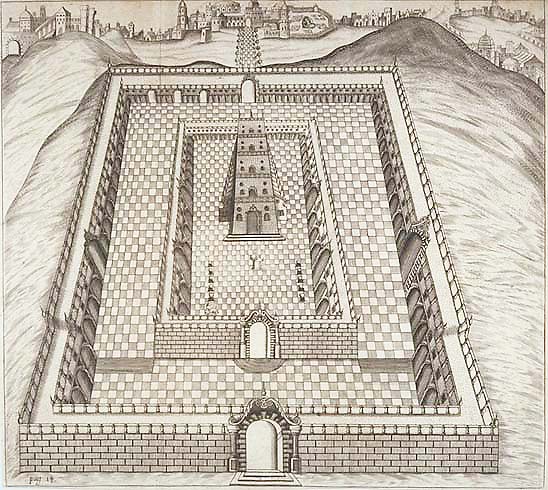
Masons--like early American Jews--were interested in mosaic pavements for a reason.  Neo-classical marble checkerboard floorings reflected a general interest in antiquity, but they were also explicitly associated with Solomon’s Temple throughout the seventeenth to nineteenth centuries. While Amsterdam Rabbi Leon de Templo depicts the interior courtyard of the Temple Mount in his model as paved in uniform square tiles, other scholars of the Temple explicitly used the checkerboard motif for the Temple’s courtyard, such as Samuel Lee in the diagram to the left. By at least 1730, mosaic pavement design (often in the form of a floor cloth) was a mainstay of Masonic Temples because of the pavement’s Solomonic association. When early Masons met in coffee shops, they decorated the meeting spaces with Temple motifs.

Indeed, until the nineteenth century when lodges expanded their membership and more routinely acquired property, lodges used portable symbols, badges and signs to signal connections to Solomon’s Temple and set an appropriate mood for meetings. Other important Temple symbols used in masonic rites included the Ark of the Covenant and the pillars of Jachin and Boaz (the two pillars in the emblem chart above).  Even the apron worn by masons (such as George Washington below) has been read as related to ephod (apron) of the sacred garments of the Kohen Gadol, shown below on the left of the frontispiece of the Amsterdam Haggadah of 1695.

George Washington in Masonic Regalia, including the Masonic Apron. "Washington as a freemason," ( c1867). Courtesy of the Library of Congress, LC-DIG-pga-04176


Seder Haggadah shel Pesah (Passover Haggadah) (Amsterdam, 1695). Library of Congress, Hebraic Collection.


To learn more about connections between Jews and Masons, see my earlier post on Masonic Jews and my chapter on  "The Secret Lives of Men" in Messianism, Secrecy, & Mysticism: A New Interpretation of Early American Jewish Life (2012).  In my book, I talk about some of the key differences between the Jewish and Masonic uses of mosaic pavement, and the reasons why freemasonry was popular among early American Jews.

0

Rabbi's Houses in Colonial America

I have been thinking lately about Rabbi's houses in colonial America, in part because I will be speaking about early American Jewish houses at the AJS (Association for Jewish Studies) Conference in December, and in part because I have been transcribing a section of the minute books of Congregation Nidhe Israel in Barbados in which the Rabbi, his house, and his household keep getting mentioned.  Today the historical Rabbi's house in Curaçao is a tranquil oasis, but apparently during the colonial era the houses were vibrant places to visit or live.

In Curaçao, like in Barbados, Suriname, and Amsterdam, the Rabbi's house was part of the synagogue complex that also included a mikveh (ritual bath), school space, and the synagogue itself, called the “Snoa” in Curaçao and Esnoga in Amsterdam (Ladino: אסנוגה).  Although the house in Barbados has been destroyed, the Rabbi's house in Curaçao is still standing and is beautifully maintained as part of the exquisite Jewish Historical Museum.

Panorama of the Rabbi's House on Kuiperstraat (Stevan J. Arnold, ©2012)
 

Detail (Stevan J. Arnold, ©2012)


The Rabbi’s House was built in 1728 at 26-28 Kuiperstraat, in the heart of the older Punda neighborhood.  Although it became part of the a group of buildings that now form the synagogue complex, the house predated the placement of the synagogue: as the Jewish population on the island flourished, the congregation outgrew its initial space and moved in successively in 1671-75, 1681, 1690, 1703. In 1729 the fifth synagogue was destroyed in order to build the sixth (and final synagogue) adjacent to the Rabbi’s home.  Although early on a house was adapted to meet the congregation’s needs, both in 1703 and 1732, the community built a structure explicitly as a synagogue. The current house was likewise an extension of a predecessor.  In 1704 the Mahamad (Board of directors or council of elders of a Spanish-Portuguese Synagogue) bought a larger house for Rabbi Eliau (Elijah) Lopez and his successors.  This house was “revised” in 1728, the date it now bears (Emmanuel & Emmanuel, History, 51, 87-88, 93-95, 120-24, 143, 1163).  Unlike Merchant houses, which often housed offices or goods for sale and were located near the wharf, the “business” of the Rabbi’s house was primarily ritual and liturgical. By the 1730s the Snoa had to compete with a second synagogue and Jewish school in Otrobanda, though the Snoa complex still laid claim to being the house of the Island's Rabbi.

Panorama of the Rabbi's House (Photo by Stevan J. Arnold, ©2012)
Architecturally the house shares many features with its neighbors, including the graceful balconies (shown above and below) that were so popular in the Punda neighborhood during the eighteenth and nineteenth centuries that helped keep residents cooler. Like Amsterdam’s canal houses, older houses in Curaçao were usually built with brick.  Unlike in Amsterdam, however, where the brick was left exposed, in Curaçao the brick was typically covered in plaster or stucco (Winkel-151-55).The plaster was then whitewashed or painted in a “bright bold palette” not favored in the Netherlands.  Allegedly houses began to be painted because an early governor found the white-washed buildings “fatiguing to the eye” due to the way the reflected the tropical sunlight.


Balcony of the Rabbi's House (Photo Stevan J. Arnold, ©2012)
To visit this lovely historical house, pay the small entrance fee and enter through the main gates of the Snoa.


Resources:
  • http://www.curacaomonuments.org 
  • Emmanuel, Isaac S. and Emmanuel, Suzanne A., History of the Jews of the Netherlands Antilles (Cincinnati, OH: AJA, 1970). 
  • Winkel, Pauline Pruneti, Scharloo: A Nineteenth Century Quarter of Willemstad, Curaçao: Historical Architecture and its Background (Florence: Edizioni Poligrafico Fiorentino, 1987).
 

0

Gravestone Resources


The Jewish Atlantic World Database has over 3,000 photos of gravestones.  Most of these are Jewish gravestones, though there are also stones from a slave cemetery in Newport and a Creole Cemetery in Suriname.  I have included in the database handouts for using gravestones in the classroom or for genealogical research on the resources page. For an introduction on why scholars use gravestones and what to look for in gravestones watch these short webinars:


Enjoy!


0

Jewish Atlantic World Database Now on the Web!

The Jewish Atlantic World Database is now open and free to use! In the collection, you will find over 5,000 images related to Jewish life in early America.  The database includes both photos of material culture (gravestones, ritual baths, synagogues, houses, furniture, etc.) and archival documents (probate records and land evidence) from many of the key ports where Jews settled in North America and the Caribbean, as well as several crucial ports from which they immigrated (Amsterdam, London, Hamburg).  Also included in the database are samples of non-Jewish (and later Jewish) artifacts to allow students to better assess what made Jewish life distinctive.  Keywords allow visitors to connect artifact to other items related to the same individual, family, ethnic group, location, port town, or theme.  Right now you can browse or search, or look for records by the individual's name.  Soon we hope to have a complete list of family names to browse as well.  You will also find resources to help you analyze the objects in the database or to use in the classroom.  Looking for something or someone and can't find it/them?  Let me know, as we are still adding items to the database each week!  Here are some important colonial Jewish families you will find in the database: Lopez, Henriquez, Senior, Curiel, Gomez, Hoheb, Hart, Rivera, Maduro, Seixas, and many many others.

Book coverThis collection began when I was doing research for Messianism, Secrecy, and Mysticism: A New Interpretation of Early American Jewish Life.  In this book, I am interested in the ways in which colonial American Judaism was as much an embodied religion as it was a textual or faith-based practice.  That is, I argue that we should think of colonial American Jews as a “people of the body” as well as a “people of the book,” and I look to the ways that everyday objects helped define and create Jewish identity. By sharing the images used to create this book, I hope to enable students, scholars, and family historians to trace the paths that early American Jews (and their objects) took, as well as to gain a richer sense of their everyday lives.

If you would like to learn more about the religious life of early American Jews and the objects they used, please feel free to order a copy of Messianism, Secrecy, and Mysticism: A New Interpretation of Early American Jewish Life from ISBS or Amazon.com. Purchase of the book is optional, however; this website is freely available to the public as an educational, not-for-profit tool for teaching and learning.

Landhuis Klein Santa Marta (ca. 1700), Curacao. Home of Aaron Levy Maduro (1709-19); Jacob Joshua Naar (1819-56), and Joseph Jacob Henriquez (1856-62)

2

Can You Solve This Genealogy Question?

I have a genealogy mystery question for you! Those who are interested in Sephardic Genealogy will know that traditionally Sephardic Jews often named their children following a strict naming pattern:

1. Firstborn son named after paternal grandfather
2. Second son after maternal grandfather
3. First daughter named after paternal grandmother
4. Second daughter after maternal grandmother
5. Next child after the paternal uncle or aunt,
6. Next child named after maternal uncle/aunt,
7. And so forth (Malka 77-78).

Yet, in the Portuguese Jewish cemetery of Amsterdam, we find a relatively larger number of men named Abraham v'Abraham (Abraham son of Abraham) while only 14 men who were Moses were Moses v'Moses (Moses son of Moses) (out of 27,764 records).

How might we explain why more men named Abraham seem to have been named for their fathers?

A prize will go to the person who posts the best answer below in the comments!

For answers to this question and others, join me for a two-part Jewish genealogy workshop in Seattle on Mercer Island on Monday Jan. 9th with the Jewish Genealogical Society of Washington State.
Part 1: Sephardi and Ashkenazi Jews in the Americas, 1620-1820
Part 2: Tracing Family History Through Architecture.


RESOURCES CITED:
Malka, Jeffrey S. Sephardic Genealogy. Bergenfield, NJ: Avotaynu Inc., 2002.

Photo detail of the gravestone of Abraham, son of Benjamin Senior (1727) by Laura Leibman, from the Beth Haim Ouderkerk aan de Amstel

0

Rabbis of Renown: The Ramchal

I am an unabashed fan of the Ramchal--Rabbi Moshe Chaim Luzzatto (1707-1746). He is one of those authors whose works I return to again and again. Yet, I often feel like there are two Ramchals. There is the tzaddik who spawned the modern mussar (ethics) movement who work is taught in orthodox yeshivot around the world. Then, there is the sometimes heretical, messianic mystic studied by academics. Can these be the same person?

Recent publications of some of the Ramchal's mystical masterpieces (including 138 Openings of Wisdom and Secrets of the Future Temple: Mishkney Elyon) by Rabbi Avraham Greenbaum have begun to close this gap, by showing the importance of the Ramchal as a mystical thinker as well as ethical philosopher. In my own scholarship, I've tried to understand why the Ramchal became such a crucial figure for mainstream Judaism by looking to how he reveals the logic of mysticism and how he answers the fundamental theological questions of his era.

Rabbi Moshe Chaim Luzzatto (1707-1746) was born in Padua (Italy) and died in Acre, near Tiberius (Israel). In between, he settled in Amsterdam where he wrote many of his most famous works, including Mesillat Yesharim (The Path of the Just) and possibly Derech haShem (The Way of G-d). These works answered a basic need in the Sephardic community, particularly the questions raised by the large numbers of conversos arriving in Amsterdam due to late waves of the Inquisition. These are questions that still plague us today. Do our acts matter for salvation? How can we gain knowledge of God’s plan? What is the relationship between the physical realm and the spiritual? What is the meaning and purpose of life? If God is in charge of the universe, how can I have free will?

The Ramchal’s writings were (and are) powerful because they addressed the great questions and concerns of his day; moreover, his answers revealed that the major “threats” to Jewish practice were not as threatening as people might have thought. Thus it should not surprise us, that works like Mesillat Yesharim and Derech haShem were almost immediately accepted as central formulations of Jewish belief, despite the fact that the Ramchal authored other more controversial messianic manuscripts.


Ramchal Synagogue in Acre © Yourway

Like any good fan, as soon as there is another edition of one the Ramchal's books, I rush out to get it. Hence I was thrilled when my copy of the Ofeq Institute's Complete Mesillat Yesharim arrived. I own several other versions of Mesillat Yesharim, but this version is already by far my favorite. I suspect that the new Ofeq edition of The Complete Mesillat Yesharim (superbly edited and translated by Avraham Shoshana) will appeal to readers new to the Ramchal as well as fans like myself.

The edition has many strengths. First, the translation is lively and very readable. Second, the notes are excellent and insightful, but not intrusive. Third, the introduction is succinct and still helpful. Fourth, the book contains both the "dialogue" and "thematic" versions of this classic work.

It is this fourth element that will ensure the Ofeq edition is an immediate classic and is necessary to any serious study of the Ramchal. The "thematic version" is the one most commonly found in print, and is based on a revised version of the 1740 edition of Mesillat Yesharim from Amsterdam. The dialogue version is based on a 1738 manuscript in the Guenzberg Collection of the Russian State Library in Moscow. This "version" takes the form of a dialogue between a hakham (wise man) and a hasid (a pietist). Although the 1740 edition of Mesillat Yesharim was both generated from this dialogic text and is an abridgement of it, the manuscript was an independent work, not a "draft." One of the geniuses of the Ofeq edition is that it allows readers to toggle back and forth between the two versions and learn from the comparison. Indeed, there is a comparative study of the two versions at the end of the volume. At $35.99 (and 672 pages) this beautifully printed edition is a bargain.

If you are new to the Ramchal, you might find it helpful to read Derech haShem before trying Mesillat Yesharim. Likewise, I find that the Ramchal's more openly kabbalistic texts 138 Openings of Wisdom and Secrets of the Future Temple: Mishkney benefit both from an introduction to kabbalism and a thorough reading of his other works. Here are a few resources that people may enjoy:

Resources on the Ramchal

0

Keep This Classic Cemetery Open to the Public!

Beth Haim Ouderkerk is the most magnificent and important of the historic cemeteries in the Jewish Atlantic World. It is the birthplace of the unique Sephardic sepulchral tradition that spread throughout Hamburg, London, Newport, New York, and the Caribbean in the seventeenth and eighteenth centuries.

The cemetery opened in 1614, and some of the oldest (and most famous) stones imitate the coffin-shaped style found in medieval Spanish Jewish cemeteries and Sephardic cemeteries in the Ottoman Empire. These stones have been memorialized in paintings and drawings by Dutch artists like Romeyn de Hooghe (1645–1708) and Jacob van Ruysdael (1628/9-1682). By the final quarter of the seventeenth century, a distinctive tradition emerged in the cemetery: flat table stones with a predilection for elaborate carvings that often include death’s heads, angels, biblical scenes, the hand of God cutting down the tree of life, and heraldic images. Members of the Sephardic elite in the colonies imitated these stones, and often even imported stones from Amsterdam before their death. This incredible cemetery has been open to the public and available as an important heritage site for travelers and scholars from around the world. The site is also a priceless resource for genealogists.


Gravestone featuring Daniel and the Lions, Beth Haim Ouderkerk (Photo by L. Leibman, 2009)

The recent economic crisis is also hitting Beth Haim Ouderkerk. The lack of donations have created a situation where the annual municipal subsidies may be withdrawn. The lack of these funds will halt maintenance work and make it difficult to keep the cemetery open to the public.

You can help! As this tax season ends and you consider making charitable donations, keep Beth Haim Ouderkerk in mind. You can also support the cemetery by purchasing books about the cemetery. All proceeds go to the Beth Haim.

To learn more about this classic cemetery, please enjoy the most recent newsletter (Thank you to Dennis Ouderdorp for being willing to share it!):
De Castro Newsletter 17-1


All photos from Beth Haim Ouderkerk by Laura Leibman, 2009.

3

Masonic Jews

Phil Belinfante recently asked me about a gravestone of one of his Jewish ancestors that had masonic symbols on it. The gravestone was that of Judah Cappé (1799-1878) of St. Thomas. The stone lies in the Jewish Cemetery in St. Thomas and features a Masonic square and compass with a G inside surrounded by a laurel (right). The square and compass are the most universal symbols of freemasonry: the tools are understood "emblematically" to "remind the Mason to square his actions by the square of virtue, [and] to circumscribe his passions and desires with a symbolic compass" (Morris 5). The "G" is stands for how God (or geometry) is at the center of freemasonry. Laurels are a sign of divine blessing (and victory) and are associated with the Scottish Rite.

Phil wanted to know (1) if it was common for Jews to be Masons during this era, and (2) if so, why?

The answer to the first question is relatively simple: yes. Many prominent Jews in the American colonies were masons and they often decorated their gravestones with Masonic symbols. Some joined regular lodges, others created Jewish-themed lodges, such as the King David's Lodge of New York, Newport, and Massachusetts. Men like Michael Moses Hays and Moses Seixas rose through the masonic ranks to become grand masters. Masonic symbols can also be found on ketubot (marriage contracts) and even the lintel for Temple Emanu-el in Curaçao (above left), as well as gravestones. Although some communities (such as Curaçao) had separate non-denominational masonic cemeteries, Jewish Masons tended to be buried in Jewish cemeteries and to show their affiliations with the masons through symbols on their stones.

The second question is more complicated: why be masons? Fraternal organizations in general were extremely popular starting in the eighteenth century. As historian Steven Bullock explains, freemasonry provided a welcome relief for Restoration Britons who otherwise were awash in religious and political factionalism: “doctrinal and sectarian differences were to be laid aside within the Masonic family.” The Masons expressly banned discussions that might lead to controversy, including quarrels about religion. Nor was religious belief used to define membership. Brotherhoods allowed Jews to forge business and social connections with the wider community of elites in their port towns. Moreover, Masonic rituals that lauded the Jewish origins of the group probably helped make Jews feel at least partially at home in the organization. Some masonic "secrets" (as well as the general interest in symbols) drew upon known mystical traditions, including kabbalism, which may have also made Jews feel an affinity for masonic rites.

Did being a freemason mean one was less devoted to Judaism? As Phil points out, "One would think being a Jew was enough of a full time ... life." While many orthodox Rabbis today would probably see freemasonry as antithetical to Judaism, at least some early American Jews seem to have believed that the two were compatible. Joseph Chayyim Mendes Chumaceiro (Amsterdam 1844-Curaçao 1905), who served as the Chazan for in Charleston, New Orleans, Philadelphia, and Georgia as well as Curaçao, wrote an extended treatise on the evidences of freemasonry in "Ancient Hebrew Records." The degree to which Jews actively practiced both Judaism and freemasonry probably varied tremendously.

Let's turn back, then, to Judah Cappé. Judah was the son-in-law of Samuel Hoheb and the husband of Sara de Samuel Hoheb (ca. 1796-1863). According to the history of the Harmonic Lodge, they lived downtown at 22 Commandant Gade (right). Sara's gravestone indicated that they had four children that survived her death. As Judah's stone suggests, he was active in the masons. The Harmonic Lodge's records support this and indicate that key meetings were held at the Cappé house. Judah was also active in the Synagogue. When a fire destroyed the synagogue in 1831 and the community had to rebuild the structure, the Cappés held a dinner and ball at their house in honor of the laying of the first cornerstone in December of 1832 (Cohen 46). In spite of this support, the family does not appear to have been completely shomer shabbat (sabbath observant): Cohen notes that the auction houses owned by Judah and his father-in-law "ran their swiftest business on Saturdays." Yet, when Cappé's duties as "consul to the Netherlands" conflicted with religion, he chose Judaism: when the King's birthday fell on a Saturday, "Cappé moved the planned fireworks celebration to Sunday" (Cohen 60, 126, 254 fn63). Like many Jews in the Atlantic World (and today), Judah's religious beliefs and observances were complex.

Judah's tombstone is all in English, but pays allegiance to both his beginnings (in the Jewish community of St. Eustatius) and the heritage he left to his son, named for Judah's father-in-law Samuel Hoheb. The inscription reads

Sacred
to the memory of
JUDAH CAPPE
Born in the island of St. Lusiastius [Eustatius]
on the 9th of April 1799
And summoned hence on the 4th day
of November 1878
Aged 70 years and 8 months
This stone has been erected
as a mark of filial affection
by his son
SAMUEL

Here are a few more gravestones of Jewish Masons that people may enjoy.


Gravestone of thirty-first-degree Mason Isaac Moises Penso (1878). Temple Emanu-él section of Beit Haim Berg Altena, Curaçao


Gravestone of Grand Master Moses Michael Hays. Touro Cemetery, Newport RI. Although Hays helped start King David's Lodge and was the Grand Master in New York, Rhode Island, and Massachusetts, there are no Masonic symbols on his tomb.

Does anyone else have a Jewish gravestone about which they have questions?

RESOURCES

Bullock, Steven C. Revolutionary Brotherhood: Freemasonry and the Transformation of the American Social Order, 1730-1840. Chapel Hill: University of North Carolina Press, 1996.

Chumaceiro, Joseph Chayyim Mendes. The Evidences of Free-Masonry from Ancient Hebrew Records. Augusta, GA: 1896; New York: Bloch, 1921.

Cohen, Judah. Through the Sands of Time: a History of the Jewish community of St. Thomas. Hanover: U. Press of New England, 2004.

History of the Harmonic Lodge, a Freemasons Lodge in the Virgin Islands. http://www.harmoniclodge.com/a_short_history_of_the_harmonic_.htm>

Margolinsky, J. 299 epitaphs from the Jewish cemetery in St. Thomas, West Indies, 1837-1916, with and index; compiled from records in the archives of the Jewish Community in Copenhagen. Copehagen: 1965.

Morris, S. Brent. The Complete Idiot's Guide to Freemasonry. New York: Alpha, 2006.

0

Rabbis of Renown: Rabbi Haim Isaac Carigal

Rabbi Carigal was born around 1729 and died in Barbados in 1777. He was one of the many emissaries that visited the American colonies from Europe and the Four Holy Cities in Israel (Safed, Hebron, Tiberias, and Jerusalem). These emissaries not only played an important role raising funds for yeshivot, but also brought learning to the edges of the Jewish diaspora.

Although Carigal lived for several years in London and Barbados, he is most famous among American Jews for having visited Newport (RI) in 1773, where he delivered a Shavuot sermon that became the first published Rabbinical address delivered in what would become the United States. He also became life-long friends with Ezra Stiles (affectionately known by me as the "Harriet the Spy of the Colonial World"), who took copious notes on their visits together and transcribed their letters back and forth. Today Carigal's sermon, along with Stiles' records comprise the two main textual resources we have on the Rabbi, his thoughts, and his life. We also have his will, written in Barbados shortly before his death at the young age of 48 (see below). These written sources are complemented by two objects that round out our sense of the Rabbi: a portrait commissioned by Stiles from artist Samuel King (above), and Carigal's elaborately carved gravestone that rests today in the Nidhe Israel cemetery in Bridgetown, Barbados (below).

Like many Jewish gravestones in the West Indies, the inscription for Carigal's stone is in three languages: Hebrew, Portuguese, and English. The Portuguese and English portions read:

Do muy Docto Erudito & Isigne
H.H.R. Refael Haim Ishac Carigal
Illustre Cabeca do K K de Nidhe
Israel en Berbados que O'Soberano:
Jues chamo desta Transitoria Vida
em 2da Fra 12 de Iyar 5537 que cor
responde a 19 de Mayo 1777 de
48 Annos de Idade
SBAGDEG


Here lyeth the remains of the Learned
& Revd Rabbi Ralph Haim Isaac Carigal
Worthy Pastor of the Synagogue NY
who departed this life on the 19 of May
1777 Aged 48 Years.


Although carved in a beautiful marble with care, the stone lacks many of the signature symbols found in the Nidhe Israel cemetery: there are no angels, the tree of life, no scenes of resurrection like those found on stones nearby. The restraint shown on the stone speaks to the Rabbi's origins in the Ottoman Empire: although Turkish stones are often gorgeous and elaborate (as Minna Rozen has shown), they do not tend to have images of humans and divine beings (angels, hand of God) found on the stones of the Jewish Atlantic World. Rabbi Carigal's "Turkishness" fascinated Stiles when the Rabbi visited Newport. Stiles was particularly intrigued by Carigal's hat and robes, which gave the Rabbi an "Oriental" air.

As I argue in my essay on the Shavuot sermon, Carigal was an important resource for early American Jews. His sermon was stepped in Sephardic tradition and relied upon the greater learning he had had while in Hebron. Marc Saperstein argues that Sephardic sermons underwent a shift from an older derush form to a newer “catenary” style during the eighteenth century. Carigal's sermon bridges these two forms (Saperstein 78; Leibman 80). Carigal's will also reveals his undying ties to the Holy Land and the family he left behind: he asks that most of his estate be sold and divided between his wife and son, but that "my books and wearing apparel be send to ... be remitted ... to my loving wife Hori Carrigal [in London] and my loving son David Carrigal of Hebron to be equally divided share and share alike." Rabbi Carigal is an important reminder of the sacrifices Sephardic luminaries made to bring learning to the Jewish Atlantic World.


Transcription by L. Leibman of the "Will of Rabbi Raphael Haim Isaac Carrigal May 27th, 1777" (Barbados Department of Archives, Bridgetown, Barbados; RB6 25 pp. 111-12)

Entd May 27th, 1777
Barbados

In the Name of God Amen I Raphael Him Isaac Carrigal of the Parish of St. Michael in the Island abovesaid Raby being sick and weak in body but of a sound and perfect disposing mind and memory do make & publish this my last Will and Testament in manner and form following that is to say. First I recommend my soul to the Almighty God of Israel imploring his Divine Goodness to pardon my sins. Impris I direct all my just debts and funeral Expenses be first fully paid and Satisfied Item I direct all my books and wearing apparel be send to Mr. Abraham Levi Hemenes of London one of my Executors here after mentioned to be remitted by him to my loving wife Hori Carrigal and my loving son David Carrigal of Hebron to be equally divided share and share alike. Item I direct that all my estate real and personal might be sold by my Executors hereafter named and the moneys arising therefrom to be remitted to London to Mr. Abraham Levi Hemenes one of my Executors here after named to be remitted to my loving wife Hore Carrigal and my loving son David Carrigal of Hebron to be equally divided share and share alike between them both and Lastly I nominate and appoint my loving friends Abraham Massiah Isaac Lind and Matthias Lopez of this Island and Mr Abraham Levi Hemenes of the City of London Executors of this my said Will hereby revoking and making void all former or other Wills by me heretofore made. In Witness whereof I have hereunto set my hand and Seal this seventeenth day of May one thousand seven hundred and Seventy Seven.

Rephael Haim Carrigal (Seal)

Signed Sealed published and declared by the said Testator as and for his last Will and Testament in the presence of
Abm Depriza Moses Depriza Moses Lopez Junr

Barbados By His Excellency
Moses Lopez Junr one of the Subscribing Witness to within written Will this day personally appeared before me and made oath on the Five Books of Moses that he was present and did see Raphael Haim Isaac Carrigal the Testator therein named (Since decd) sign Seal publish and declare the same as and for this last Will and testament ad that he was at the executing thereof of a sound and disposing mind an memory to the best of his this deponents and Belief given at Pilgrim this 27th day of May 1777
Edward Hay


Further Readings:Karigal, Rabbi Haijm Isaac. “A Sermon Preached at the Synagogue in Newport,” Newport: S. Southwick, 1773.

Kohut, George Alexander. Ezra Stiles and the Jews. NY: Philip Cowen, 1902.

Leibman, Laura. "From the Holy Land to New England Canaan: Rabbi Karigal and Sephardic Itinerant Preaching in the 18th Century." Early American Literature 44.1 (March 2009).

Minna Rozen
, Hasköy Cemetery: Typology of Stones. Pennsylvania: Center for Judaic Studies, 1994.

Saperstein, Marc.
Jewish Preaching, 1200-1800: an Anthology. New Haven: Yale University Press, 1989.
Singer, Rabbi Shmuel, "The Chacham for the Colonies: He Came from Hebron to the New World to Serve."

Stiles, Ezra.
Literary Diary of Ezra Stiles, 3 volumes. Ed. F.B. Dexter. NY: C. Scribner's Sons, 1901.

Stiles, Ezra.
Itinerancies. Ezra Stiles papers, Beinecke Library. Yale University.


0

Family Portraits

Portraits of early American Jews tell us a lot about how Jews wanted to be seen and remembered. They also tell us about how Jews dressed and how they thought about family. Who was featured together in portraits? Where were the paintings hung? Over ten years ago, the Jewish Museum in New York featured an exhibit entitled, "Facing the New World: Jewish Portraits in Colonial and Federal America," the exhibition book for which is still a landmark in the field. Today, many early American Jewish portraits are available online through the Loeb Database of Early American Portraits at AJHS.
This summer I am teaching a MALS class on material culture in the Jewish Atlantic World. This week we've focused on portraits and representations of Jews between 1640-1840. I like to distinguish between portraits paid for by a patron (who had the power not only to choose his clothes and the painter, but also not to pay for the work if it wasn't to his liking), and paintings of Jews over which the sitter had little or no input or control. Examples of a portrait would be Gilbert Stuart's "Mrs. Aaron Lopez and Her Son Joshua" (1772/73) or Gerardus Duyckinck's "Portrait of Franks Children with Lamb" (ca. 1735). In contrast, an example of an unsolicited representation of Jews would be Pierre Jacques Benoit's "Shopkeeper and Tailor, Paramaribo, Surinam" (1839). Somewhere in between these extremes is Bernard Picart's Etchings of Amsterdam's Jews, an example of which I featured in my post on the House of the Rounds. Comparing these types of representations of Jews can help students understand the differences between how Jews were seen by others and how they wanted to be seen.

Below are some resources for other teachers who are interested in having students analyze early Jewish portraits in class.


Sylvan Barnet’s General Questions Art Historians Ask About Art1. What is my first response to the work? (Later you may modify or even reject this response, but begin by trying to study it.)

2. Where and when was the work made? Does it reveal qualities attributed to the culture? (Don't assume that it does; works of art have a way of eluding easy generalizations.)

3. Where would the work originally have been seen? (Surely not in a museum or textbook.)

4. What purpose did the work serve?
To glorify a god? To immortalize a man? To teach? To delight? Does the work present a likeness, or express a feeling, or illustrate a mystery?

5. In what condition has the work survived?
Is it exactly as it left the artist's hands, or has it been damaged, repaired, or in some way altered? What evidence of change do I see?

6. What is the title? Does it help illuminate the work? Sometimes it is useful to ask yourself, what would I call the work?
Specific Questions I Ask about Portraits
1. Was the portrait commissioned by the sitter (or the sitter’s family) or was it created without the sitter’s input?

2.Does the portrait emphasize or elide ethnic identity?

3. What social type does the sitter represent? (There may be more than one.) How do you know?

4. What is the class/social rank of the sitter? How does the painter establish the rank of the sitter? Does the social standing of the painter tell us anything about the social rank of the sitter?

5. What objects does the sitter hold or have around him/her? What message do these objects convey?

6. Is anyone else present in the portrait? Do these people help construct a communal identity for the sitter or emphasize the sitter as defined by specific relationships?

7. What is the sitter wearing? How do the clothing help establish the sitter’s identity?

8.If possible, look at another portrait by the same artist of a non-Jewish patron.What differences do you notice? What is the significance of the differences? [For example you could compare Gilbert Stuart's portrait of Sarah and Joshua Lopez to that his portrait of Christian Stelle Bannister and her son John].

9.If a child is in the portrait is (s)he presented as a “little adult” or as a child?

10.If you feel comfortable thinking about styles of art, in what style is the portrait made?


Resources for Finding Portraits
from the Jewish Atlantic World

A. ELECTRONIC

B. PRINT

0

The Magic of Probate Records

Most of us don't just want to know the names of people in the past, we want to know who they were, how they lived, what mattered to them most, who they considered family. Probate records are one important key to unlocking these mysteries. Probate records sound boring: who wants to sit around reading wills or estate inventories? I hope to show that probate records are actually a goldmine waiting to be excavated.

When I was recently in Barbados, I managed to convince my father we NEEDED to go the Department of Archives to look at probate records. I was interested in historical research, and he was interested in family history, and for both of us, probate records provided a lot of answers to our most urgent questions.

My father knew his great-grandfather's name and date of death, but he didn't know anything about how he died, what kind of life he led, or how he felt about the family he left behind. Probate records helped my father answer these questions. By finding his great-grandfather's will, he found out he owned a small plantation, had a small amount of livestock, and a carriage. The size of the plantation and the basic holdings told us their lot was not as glamorous as that of the owners of large plantations, nor as desperate as the poor whites known as "Red Legs." We discovered our ancestor cared about his children, all of whom were mentioned by name in the will, and to whom he chose to leave equal portions to "share and share alike" after his death rather than trying to consolidate wealth with his eldest son. Although we didn't find out what precisely caused his death, we did find out that he knew he was going to die reasonable amount of time before he did, suggesting that he wasn't carried off in a sudden illness. We also found out the name of plantation. With this information in hand, we looked up the deed to the plantation and found out the exact location of the family property, the date the family sold it, and the amount of the sale after debts were paid. This gave us a sense of what our great (great) grandmother had taken as a nest egg to the United States as a young woman.

Intrigued? I'd like to offer a few general suggestions on where to find probate records and what to look for when you find them, and then I'll turn to some specific examples from Barbados to talk about the significance of what people say in their wills.

1. Where to find probate records. In order to locate probate records, you will need to know when and where someone died. In the United States, probate records are usually found in the court records of the county in which the person died. Sometimes these records have either been moved to state archives (if they are early and fragile) or are available in state archives in duplicate form. Many state archives have good websites with information about what records they possess and provide research services at a small cost. (See the resources at Mass. Archives as an example.) For more specific tips on how to find the exact document once you have located the correct archive, see these Probate Research Steps. If you don't live near the archive (or even after you get there), don't be afraid to ask someone who works there for help. Some places have printed excerpts of probate records: while these are useful, I'd encourage you to look for (or order) the original document. Although they are better than nothing, synopsis often leave out personal information: precisely the details that will help you understand who the person was and what mattered to them most. If you can't read the handwriting, don't despair: there is often a later (nineteenth century or early twentieth century) transcription. These are different than synopses as they are complete and they are usually much easier to read. If there is no transcription, try my early American handwriting game to get up to speed on reading early American handwriting. You may also find the common name and abbreviation quizzes to be helpful.

2. What you may find. Probate records vary tremendously by location, date, and the wealth of the deceased. The best case scenario is that the estate will be inventoried. This provides you with a complete list of household items owned by the deceased (see image at the top of the page). Other common features are statements about the deceased's religious beliefs, a list of real property and prized personal possessions, suggestions for how they should be commemorated, the executor of the will, and a list of heirs (and their relationship to the deceased). Sometimes what people aren't given is as important as what they are given: for example, in one will I saw, a child who had married against his parents wishes was left a dollar, while other children were given vast quantities of money. Here are some examples of what you might find:

Religious Statements
Sometimes these are stock phrases, so it is worth looking to see what the "norm" is for the era. For example in eighteenth-century Barbados, many wills included some sort of religious aspirations for after death, but in the nineteenth century, religious statements were less common (my great-great-great grandfather's will had none). Here are some examples from those who did:

  1. From the will of Abigail Henriques (15 August 1755, Barbados): "First I recommend my Soule unto the hands of Almighty God in hope of his infinite mercy to obtain forgiveness of my sins and a joyfull resurrection with my breathren the Israelites, my body to the Earth to be buryed at the discretion of my Executors here after named." This statement interested me, as resurrection motifs can also be found on the gravestones at the Synagogue.
  2. From the will of Rabbi Raphael Haim Isaac Carrigal (27 May 1777, Barbados): "First I recommend my soul to the Almighty God of Israel imploring his Divine Goodness to pardon my sins." Notice how similar this is to Abigail's phrasing, suggesting a stock motif.
Prized Personal Possessions
  1. From the will of Rabbi Raphael Haim Isaac Carrigal (27 May 1777, Barbados): "I direct all my books and wearing apparel be send to Mr. Abraham Levi Hemenes of London one of my Executors here after mentioned to be remitted by him to my loving wife Hori Carrigal and my loving son David Carrigal of Hebron to be equally divided share and share alike." In order to earn his living in the colonies, Rabbi Carrigal had lived apart from his wife and son for many years. Since he was a hocham (scholar), it isn't surprising that Rabbi Carrigal prized his books, but it is touching that he wanted to make sure that his clothes were sent back to to his family! When Carrigal was in Newport, Ezra Stiles made note of Carrigal's distinctive Turkish dress, which was also featured in the portrait Stiles commissioned from Samuel King after Carrigal's death.
Suggestions for how they should be Commemorated
  1. From the Will of Sarah Belifante (4 Nov. 1785, Barbados): " I then direct that my body be interred after the Custom of the Hebrew Nation and that a white marble stone to cost eighteen pounds sterling money of Great Britain be placed over my grave I then give to the poor of the Hebrew Nation in the island the sum of twenty five pounds current money of this island to be divided amongst them at the discretion of my executors." Notice that Sarah is interested in her legacy on a variety of levels: through how she should be buried, the type of gravestone to be used, and by leaving tzedakah for the poor.
Executor of the WillWho the deceased designate to take care of their real and personal property after their death can say a lot about who they trust most. Rabbi Carrigal takes care to mention that he appoints his executors because they are his "loving friends." Likewise when Sarah Henriquez (1774 Barbados) appoints "Rachel Henriquez sole Executrix of this my Will," she does so only after noting that Rachel is her "dearly beloved friend."

Lists of Heirs
My father and I were touched that our great (great) grandmother received an equal share in the will, even though she was one of the youngest children in the family. It is worth comparing a list of descendants with those who are left money. Do the obvious people get the largest amounts of money? If the deceased has no children, who does she see as her closest kin? Sarah Henriquez left her entire estate to "Rachel Henriquez of the same Parish & Island Spinster [and] her heirs." The fact that Sarah and Rachel share the last name suggests that they were related, yet Sarah identifies Rachel as her "dearly beloved friend," not as a relative. More historical research would be useful to determine to whom else Sarah might have left her possessions.

I hope this post helps people see what gems can be found in Probate Records and encourage people to find records from their own ancestors!

0

Happy Mother's Day from Barbados

Happy Mother's Day from Barbados! Photos in are from Nidhe Israel Synagogue, Huntes Garden, St. Nicholas Abbey, Bridgetown, and other locations on the island. Music is the Brandenburg Concerto No. 6 in D Major, Czech Radio recording. All photos by Laura Leibman and Stevan Arnold.


Slideshow Version

Your pictures and fotos in a slideshow on MySpace, eBay, Facebook or your website!view all pictures of this slideshow

Video Version